

Anatomy of a Disposable Razor: Handle, Head and Blade Explained
A disposable razor contains between four and nine separate parts, depending on how the blade stack is counted, and each one has a job that shows up in use. Buyers who understand the parts can read a quotation critically, ask precise questions at the sample stage, and describe a fault accurately when one appears in a shipment.
Ningbo Jiangbei Tiansheng Plastic Products Factory has molded and assembled shaving products since 1996, and most specification disputes we see trace back to a part being described by appearance rather than by function. This breakdown works through the unit part by part.
1. The Four Working Systems in a Disposable Razor
Every disposable razor resolves into four systems: the handle, the head frame, the blade stack and the comfort element. A fifth system, packaging, is not part of the product but behaves like one because it sets how the product arrives.
The handle carries the grip and the balance. The head frame holds the blade stack at a fixed angle and provides the guard surface that limits skin contact. The blade stack delivers the cut. The comfort element, usually a lubricating strip, modifies friction after the blade passes.
Failures are easier to diagnose when they are attributed to a system rather than to the whole product. A complaint about pulling is usually a blade stack issue, while a complaint about nicking is usually a head frame geometry issue, and the two require different corrections.
2. Handle: Grip, Balance and Disposable Razor Handle Material
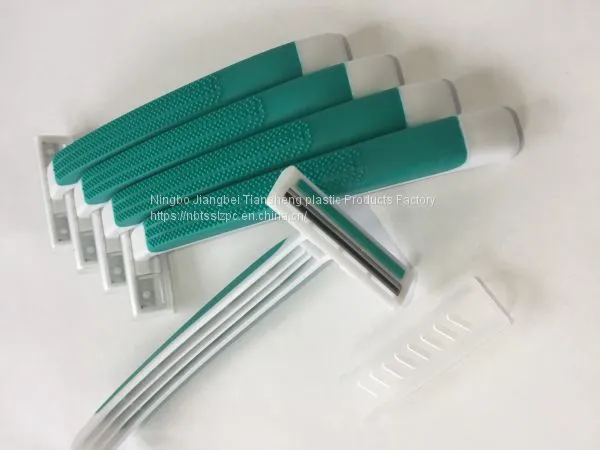
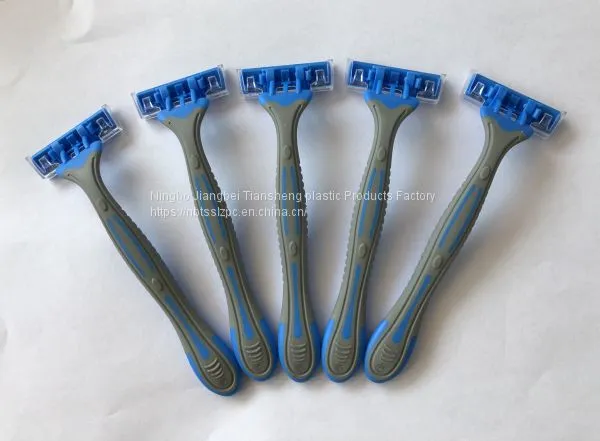
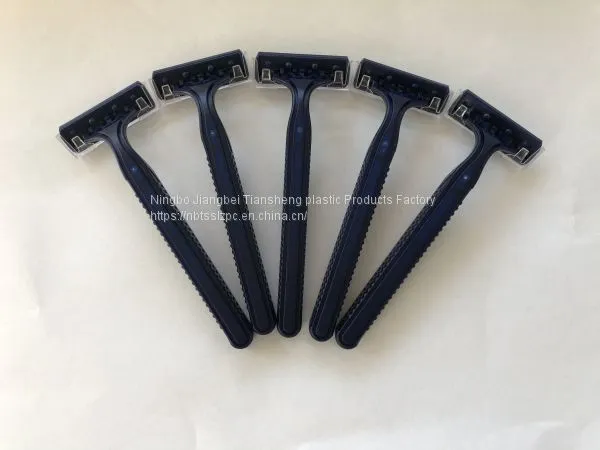
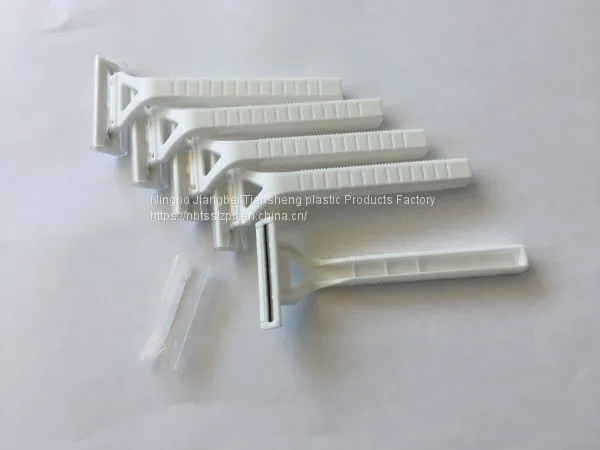
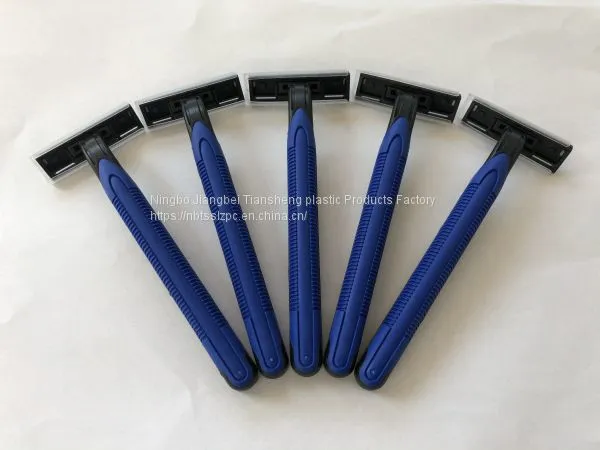
The handle is the largest molded part and the one that carries most of the perceived quality. Its length sets control, its diameter sets how it sits in the hand, and its weight sets whether the unit feels substantial.
The choice of disposable razor handle material also sets the smallest detail a buyer can specify, since texture and gloss behave differently across polymers.
Length typically runs 100 to 130 mm on a standard disposable razor, with shorter variants for travel formats. Grip diameter usually falls between 10 and 16 mm, and the difference between those extremes is more noticeable in the hand than the numbers suggest.
Disposable razor handle material is usually a rigid thermoplastic chosen for moldability and cost rather than for premium feel. Polypropylene dominates high volume lines because it tolerates living hinges and flexible snap features. Polystyrene gives a glossier finish that reads better on a retail card. ABS offers better impact strength where the unit may be dropped.
Where a buyer specifies disposable razor handle material by trade name alone, two factories will deliver two different feels from what sounds like one instruction.
Material choice interacts with the head. A handle that must accept a snap-fit head needs enough flexibility to deflect during assembly without cracking, and that requirement narrows the field quickly.
The availability of a given disposable razor handle material in a specific colour also decides how fast a repeat order can ship, because colour masterbatch is ordered per run.
Ningbo Jiangbei Tiansheng Plastic Products molds handles in house, which means a change of grip texture or colour is a tooling adjustment rather than a supplier conversation.
3. Head: Frame, Guard and Disposable Razor Head Assembly
The head frame is where the engineering concentrates. It holds the blade stack at a fixed angle, provides the guard that stretches skin ahead of the blade, and mounts to the handle through a fixed joint or a pivot.
A fixed head is molded as one piece with the handle or welded to it. A pivoting head introduces a separate part and a flex element, which adds assembly steps and a tolerance requirement at the pivot.
Disposable razor head assembly usually involves placing the blade stack into the frame, folding or clipping retaining tabs, and then attaching the head to the handle. On automated lines this happens in seconds; on manual lines the same sequence takes several operators and introduces variation.
Disposable razor head assembly is also where a new supplier is most often judged, because it is the step that depends most on fixture discipline and operator rhythm.
Guard geometry deserves more attention than it usually receives. The guard sits ahead of the blade and controls how much skin bulges into the cutting zone. A guard that is too open allows the skin to fold, which produces nicks. A guard that is too closed reduces blade contact and produces a shave that feels ineffective.
| Head part | Function | Typical specification |
|---|---|---|
| Frame | Holds blade stack at fixed angle | Rigid thermoplastic, molded to 0.05-0.1 mm tolerance |
| Guard bar | Stretches skin ahead of blade | Spacing tuned to blade exposure |
| Retaining tabs | Locks blade stack in place | Folded or clipped, inspected for lift |
| Pivot joint | Allows head to follow contour | Only on pivoting designs, spring or flex element |
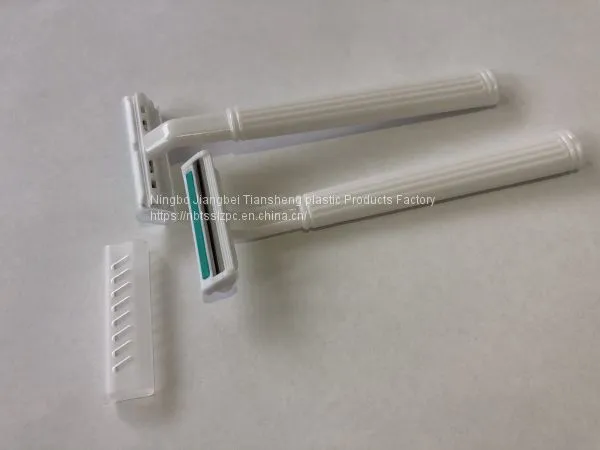
| Cap | Protects edge in transit | Snap or friction fit, retention force specified |
4. Blade: Strip, Edge and Blade Mounting in Disposable Razor
The blade stack is a set of steel strips, each ground to an edge and separated by a thin spacer. Blade mounting in disposable razor production fixes those strips at a set exposure and a set gap, and both parameters are decided by the frame rather than by the blade.
Correct blade mounting in disposable razor assembly depends on the frame seat being clean before the stack is placed, which is why a compressed air pass sits at that station.
Exposure is how far the edge protrudes past the guard. Gap is the distance between adjacent edges. Increasing exposure gives a closer shave and more irritation risk; increasing gap reduces clogging with longer stubble.
Blade mounting in disposable razor production is therefore a fixture question as much as a blade question, and buyers should ask how the stack is located rather than only what steel it uses.
Mounting consistency is what separates a good unit from an inconsistent one. A frame that allows the stack to sit a few hundredths of a millimetre high on one side produces a razor that cuts well on one pass and pulls on the next, and the user experiences this as a dull blade rather than as a mounting fault.
Any change of blade supplier requires a fresh sample approval even when the grade is unchanged, because blade mounting in disposable razor lines reacts to strip thickness before anything else.
This is why blade mounting is inspected rather than assumed. A visual check for lifted tabs, a feeler check for exposure consistency and a sample shave on a fixed panel together catch most mounting errors before packing.
5. The Lubricating Strip and Its Mounting
The lubricating strip sits above the top blade and releases a water soluble compound during the shave. Its purpose is to reduce friction after the cut, which improves comfort more than it improves closeness.
Strips are usually a polymer matrix carrying a lubricant, cut to length and bonded or clipped into a recess on the head. Bonding quality decides service life: a strip that lifts at the edge wears unevenly and can detach entirely.
- Bonded strip: lower part cost, adhesion quality critical
- Clipped strip: higher part cost, mechanically retained, more consistent
- No strip: common on economy and hotel units, lowest cost
For hotel and institutional programmes, omitting the strip is often the right call. The guest uses the razor once or twice, and the strip's benefit accumulates over repeated shaves that never happen.
6. Assembly Sequence From Molded Part to Finished Unit
Assembly runs in a fixed order, and the order explains where defects originate. Handles and frames are molded first, then the blade stack is loaded into the frame, then the comfort element is attached, then the head is joined to the handle, and finally the unit is inspected and packed.
Disposable razor head assembly should be checked with a function test as well as a visual one, because a head can look correctly seated and still sit out of alignment.
Each step adds an inspection point. Blade loading is checked for tab lift. Head joining is checked for alignment and, on pivoting designs, for function. Packing is checked for count and orientation.
Compressing the sequence is where quality suffers. A line that skips the head alignment check to raise throughput will find the resulting misalignment at the packing station or, worse, at the customer.
7. Tolerance Stack and Where Fit Failures Appear
Every joint in a disposable razor adds tolerance. The handle mold has a tolerance, the frame mold has a tolerance, the blade strip has a thickness tolerance, and the assembly fixture has a positional tolerance. Together they form a stack, and the stack decides whether a batch fits.
Fit failures usually appear at three points: the head to handle joint, the blade to frame seat, and the cap to head. A cap that fits on the sample and falls off in production is a stack problem, not a design problem.
A buyer walking a line should watch disposable razor head assembly for several minutes rather than a few seconds, since consistency shows up in the rhythm of the station.
The practical response is to specify the functional outcome rather than the individual dimensions. A cap retention force range and a head alignment check catch stack problems that dimension checks on individual parts miss.
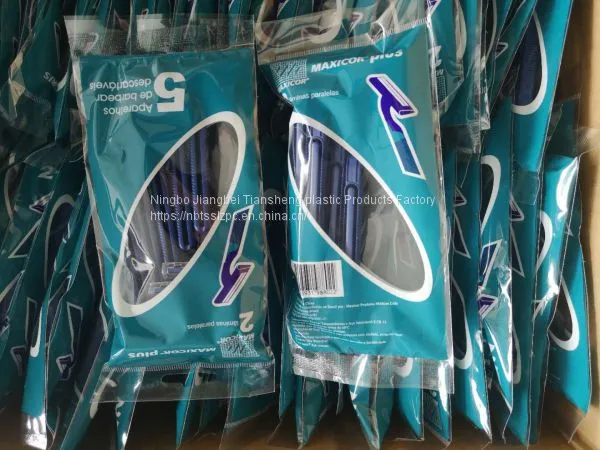
A distributor in South America received a batch in which roughly one unit in forty had a cap that released in the sachet. The cause was a mold running at the upper edge of its tolerance band on the cap seat. Tightening the band on that one dimension removed the defect without changing any other part.
8. Disassembly and Recycling Considerations
A disposable razor is difficult to recycle because it combines dissimilar materials in a permanent assembly. The handle is one polymer, the frame may be another, the blades are steel, and the strip is a third polymer with an additive.
Design choices affect recyclability more than most buyers expect. A mono-material handle and frame are easier to process than a handle with a rubber overmold, and a mechanically retained blade stack can be separated where a bonded one cannot.
Where a market imposes extended producer responsibility rules, the packaging usually attracts the fee before the product does, which is why paper sachets have spread faster than mono-material razors.
9. Inspection Points on a Finished Unit
A finished unit inspection covers appearance, function and packaging. Appearance catches colour and print defects. Function catches blade exposure, cap retention and, where relevant, pivot action. Packaging catches seal integrity, count and artwork.
- Handle: colour match to reference, no short shot, no flash on grip
- Head: blade stack seated, no lifted tabs, guard undamaged
- Cap: retention force within range, no visible gap
- Strip: bonded or clipped fully, no lifting at the ends
- Sachet: seal continuous, print legible, batch code present
- Carton: count correct, orientation consistent, carton undamaged
The factory keeps a sealed reference unit from each approved run so that a later colour or fit question can be settled by comparison.
Not long ago, a private label buyer in Western Europe returned a pallet because the handle colour drifted between two production runs. Both runs matched the Pantone reference under factory light but differed under retail lighting, and the fix was to approve colour under the lighting the product would actually be seen in.
10. Frequently Asked Questions
10.1 Which disposable razor handle material suits a hotel programme
Polypropylene is the usual choice for hotel programmes because it molds quickly, tolerates the snap features used in head assembly and keeps unit cost low. Polystyrene gives a glossier finish that suits a retail card but cracks more readily under impact. ABS is worth considering where the razor may be dropped, though it adds cost without changing the shave. For most hospitality buyers the deciding factor is colour consistency across repeat orders rather than the polymer itself.
10.2 What does disposable razor head assembly actually involve
It involves seating the blade stack in the frame, folding or clipping retaining tabs to lock it, attaching any comfort element, and joining the head to the handle. Each step has a check. Automated lines complete the sequence in seconds with fixed fixtures, while manual lines rely on operator consistency. The steps that most affect quality are tab folding and head alignment, because both can pass a visual check while still producing an inconsistent unit.
10.3 Why does blade mounting in disposable razor production matter so much
Because mounting sets blade exposure and gap, and those two parameters decide how the razor actually cuts. A stack that sits slightly high on one side produces pulling that users report as a dull blade. The blade itself may be within specification. Inspecting mounting separately from blade grade is what allows a factory to tell the difference when a complaint arrives.
Recently Posted
-
Disposable vs Cartridge Razor: Key Differences for B2B Buyers
November 24, 2026Importers often receive two quotations for what looks like the same product and find a cost gap of 30 percent with no obvious caus Read More
-
Quality Control in Disposable Razor Manufacturing
September 4, 2026A private-label buyer once accepted a large production run based on a favorable sample and a competitive quotation. The first cont Read More
-
Travel-Size Disposable Razors for Airlines and Travel Retail
September 4, 2026A regional airline once sourced its onboard grooming kits from three different suppliers to keep costs low. Each kit included a co Read More
-
Blade Sharpness Standards and Testing Methods for Disposable Razors
September 3, 2026A distributor in Africa once switched suppliers to save a fraction of a cent per razor. The new factory's blades looked identi Read More

Contact Us
Recommended Products
-
 TS-C229-A Disposable Razor Male FemaleNegotiableMOQ: 10000 Pieces
-
TS-C228 Disposable RazorNegotiableMOQ: 10000 Pieces
-
TS-C239 Disposable RazorNegotiableMOQ: 10000 Pieces
-
TS-C205 Disposable Razor With Two BladeNegotiableMOQ: 10000 Pieces
-
TS-C229A Disposable Razor ShaverNegotiableMOQ: 10000 Pieces
-
Disposable RazorNegotiableMOQ: 100 Pieces
-
TS-C216 Disposable Razor Personal CareNegotiableMOQ: 10000 Pieces
-
TS-C228 Disposable Razor ShaverNegotiableMOQ: 10000 Pieces
-
TS-212 Disposable Razor With Two BladeNegotiableMOQ: 10000 Pieces
-
TS-C229-A Eco-Friendly Disposable Shaving Razor Male FemaleNegotiableMOQ: 10000 Pieces
-
TS-C232 Disposable Hotel Shaving RazorNegotiableMOQ: 10000 Pieces
-
TS-C236 Eco-friendly Straw 2 Blade Shavers Wholesale Hotel Disposable RazorNegotiableMOQ: 10000 Pieces
-
TS-C209A Disposable Razor Shaver Four BladeNegotiableMOQ: 10000 Pieces
-
5-pc Disposable Razor ShaverNegotiableMOQ: 10000 Pieces
-
TS-C219 Eco Friendly Safety Wheat Straw Lady Men Hotel Travel Shaver Disposable RazorNegotiableMOQ: 10000 Pieces