

Men's vs Women's Disposable Razors: Design and Demand Differences
A buyer opening two cartons side by side often finds that the men's and women's razors inside are closer than the packaging suggests. The handle may be the same length, the blade count the same, and the difference limited to a colour and a printed word. That is not a failure of design. It is a commercial decision that reflects where the two products are sold and how they are used.
Ningbo Jiangbei Tiansheng Plastic Products Factory produces both variants from shared tooling in some models and separate tooling in others, and the split between the two approaches is worth understanding before a range is planned. This guide covers the design points that matter and the demand patterns behind them.
1. Why the Category Splits at All
The split exists because the shaving task differs by body area rather than by the person doing it. A face has denser, coarser hair over a contoured surface. Legs and underarms cover a larger area with finer hair and more changes of direction.
Those differences translate into three engineering requirements: head size and angle, handle length and reach, and the amount of lubrication needed after the blade passes.
A product designed for one task can be used for the other, and many buyers rely on that overlap to simplify a range. The question is whether the simplification costs more in lost sales than it saves in stock keeping.
2. Men's Disposable Razor Design: What Changes
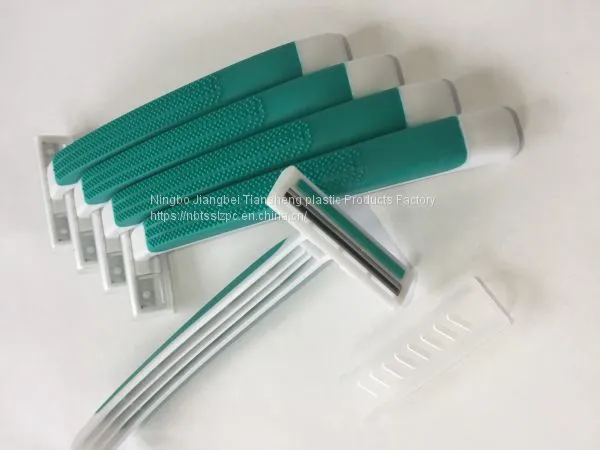
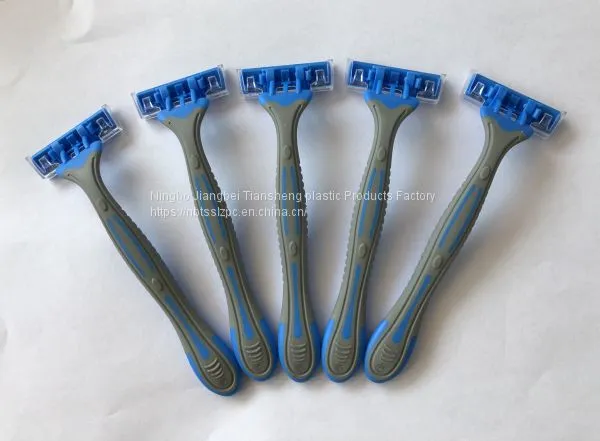
A men's disposable razor design usually prioritises control around the jaw, chin and upper lip. That means a narrower head, a shorter handle for precision, and a guard geometry that keeps skin taut over curved areas.
The precision requirement is what separates a men's disposable razor design from a scaled-down unisex unit, because a wider head cannot follow the jaw line closely.
Head width commonly runs 38 to 42 mm on a men's unit, with handle length between 105 and 125 mm. The shorter end of that range suits precision work, while the longer end suits a broader grip.
Blade count in men's disposables clusters at twin blade for volume and triple blade for the mid tier, with four blade units occupying a narrow premium band. The blade count is more visible in men's marketing than in women's, which makes it a specification buyers are pushed to raise.
A men's disposable razor design sold on a card also has to leave room for specification copy, which pushes brands toward a darker handle that photographs against white packaging.
Lubrication matters but is applied differently. A men's unit often carries a narrow strip above the top blade, sized to reduce friction on a small area rather than to cover a large one.
A men's disposable razor design that has to serve hotel and institutional channels usually drops the strip entirely, because a single-use guest razor does not accumulate the friction a repeated home shave does.
3. Women's Disposable Razor Head: Size, Angle and Lubrication
A women's disposable razor head is generally wider and set at a different angle. Width commonly runs 42 to 50 mm, and the extra span reduces the number of passes needed over a large area.
A women's disposable razor head also tends to carry a wider guard, since the guard has to stretch a larger area of skin ahead of the blade on a single stroke.
Angle is the less obvious difference. A head set closer to perpendicular to the handle suits the long strokes used on legs, while a more acute angle suits the short strokes used around a jaw.
Where a women's disposable razor head is molded in one piece with the handle, the wider head changes the balance point and the unit begins to feel head heavy unless the handle is lengthened.
Lubrication is where the two diverge most. A women's unit typically carries a broader strip, sometimes wrapping around the head, because the skin area covered per shave is larger and friction accumulates faster.
| Element | Men's unit | Women's unit |
|---|---|---|
| Head width | 38-42 mm | 42-50 mm |
| Head angle | More acute to handle | Closer to perpendicular |
| Handle length | 105-125 mm | 115-140 mm |
| Handle colour | Dark, neutral, metallic | Light, pastel, printed |
| Lubricating strip | Narrow, above top blade | Broader, sometimes wrapped |
| Dominant blade count | Twin, then triple | Triple, then twin |
| Packaging | Card, sachet | Card, box, multi-pack |
4. Handle Ergonomics and Reach
Handle length follows the reach requirement. A leg shave involves reaching the ankle and the back of the knee, which rewards a longer handle. A face shave involves the underside of the chin, which rewards shorter, more controlled movement.
Grip diameter also differs. A slightly larger diameter helps with a longer stroke because the hand closes less tightly, while a smaller diameter gives finer control for detail work.
Sizing a women's disposable razor head for a multi-pack is easier than for a single card, because the pack hides the proportion between head and handle that looks wrong on a card.
These are tendencies rather than rules, and plenty of units ignore them successfully. Where a buyer wants one handle for both variants, the compromise usually lands at 115 to 120 mm with a mid-range diameter, which neither user finds uncomfortable.
Handle colour carries more commercial weight in the women's segment, where the unit is often displayed alongside body care products. Colour variety raises the number of stock keeping units without changing tooling, which makes it the cheapest way to broaden a range.
5. Blade Count Strategy Across the Two Segments
Blade count also interacts with head width, because the same blade count spread across a wider head increases blade spacing and changes how the unit clears longer stubble.
Blade count is the specification buyers negotiate most and users notice least, provided the count stays within a reasonable band. In practice, twin and triple blade units cover most of the market in both segments.
Women's units skew slightly higher on blade count because the marketed benefit, fewer passes, aligns with the larger area. Men's units skew slightly lower at the volume end, because the shave area is smaller and the unit cost pressure is greater.
Four blade units exist in both segments and sell on a premium claim rather than on a measurable benefit. Buyers should treat four blade as a positioning decision rather than an engineering one.
- Twin blade: volume, hotel, promotional
- Triple blade: mainstream retail, both segments
- Four blade: premium positioning, narrow volume
- Single blade: economy, institutional, request-only supply
6. Packaging and Shelf Logic
A buyer planning a first range should decide the packaging format before the blade count, because the format sets the price ceiling and the price ceiling sets the blade budget.
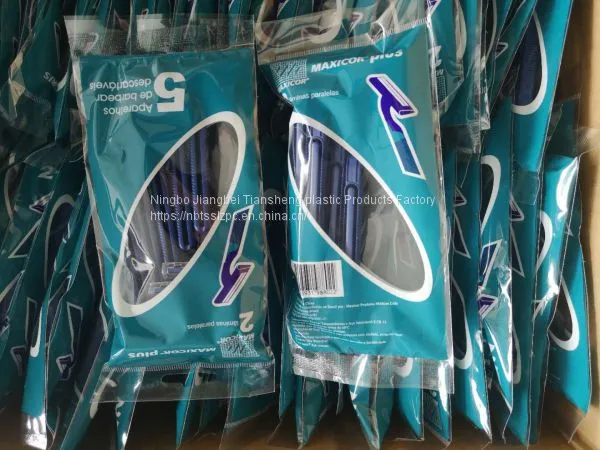
Packaging separates the two segments more sharply than the product does. Men's units are often carded and hung, while women's units are more often boxed or sold in multi-packs.
Multi-packs change the economics. A three-pack of women's razors moves more units per transaction and reduces packaging cost per razor, while a single carded men's razor keeps the entry price low.
Colour on the pack follows the same logic. Women's packaging tends to use lighter palettes and more imagery, men's packaging tends toward darker palettes and specification copy.
For private label, the packaging decision often precedes the product decision, because a brand approved for a carded slot has limited room for a boxed format.
7. Unisex Disposable Razor Demand
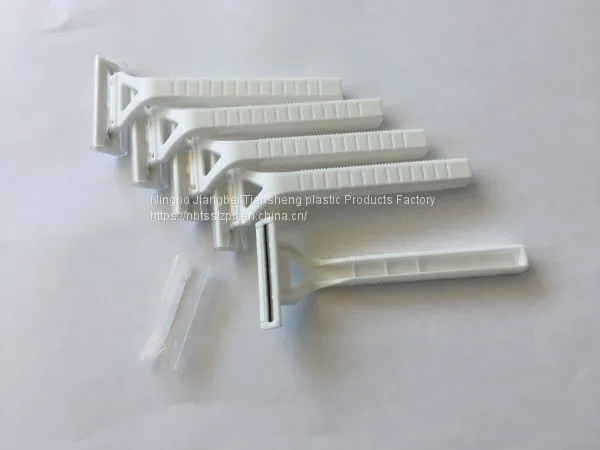
Unisex disposable razor demand is real but concentrated in specific channels. Hotels, hospitals, airlines and institutional supply all prefer one specification, because a single item code simplifies stocking and reduces the chance of running short of one variant.
Unisex disposable razor demand also clusters in markets where shelf space is allocated by function rather than by segment, since a single facing covers the whole need.
In retail, unisex units appear mainly in value ranges and in travel formats, where the shopper is buying a function rather than a positioning. A unisex unit is usually a men's geometry in a neutral colour, sold without a gendered claim.
A buyer testing unisex disposable razor demand for the first time should start with one specification in one colour and measure sell-through before adding a second colour.
The commercial logic is straightforward. One specification halves the stock keeping units, simplifies forecasting and removes the risk of a colour imbalance at the end of a season.
Ningbo Tiansheng Plastic Products Factory supplies unisex specifications to hospitality buyers and gendered specifications to retail buyers from the same handle family, which keeps tooling shared while the packaging diverges.
8. Demand Patterns by Market
Demand for the two segments varies by market in ways that affect range planning more than product design. Markets with a strong drugstore channel tend to carry both segments in depth, while markets dominated by discount grocers tend toward a narrower range with more unisex units.
Distribution structure matters as much as climate, since a market served mainly through pharmacies carries a different assortment from one served through discount grocery.
Climate plays a role in the women's segment, where shaving frequency rises in warmer months. A buyer in a seasonal market should plan the women's range around a peak rather than around an annual average.
Where unisex disposable razor demand comes from a tender rather than a shelf, the specification is usually fixed by the tender document and leaves little room for colour decisions.
Institutional demand is largely unisex and largely insensitive to season, which makes it a useful base load for a supplier and a useful anchor order for a buyer building a first range.
Not long ago, a distributor in South America launched a four-item range with two men's and two women's specifications and found that one women's colour accounted for most of the women's volume while the other stalled. Reducing to one women's colour and adding a third men's variant improved sell-through without changing the total unit count.
A smaller case: a hotel group in Southern Europe replaced two gendered specifications with one unisex unit in a neutral colour and cut its amenity stock keeping units in half, with no measurable change in guest feedback.
9. Planning a Range Without Over-Extending
- Decide whether the channel needs one specification or two
- Keep handle tooling shared where possible to protect unit cost
- Use colour to create variety instead of new tooling
- Set blade count by channel rather than by segment alone
- Limit packaging formats to those the channel will actually display
- Forecast the women's range against a seasonal peak, not an average
These six points cover most of the range decisions that go wrong. The most expensive error is commissioning separate tooling for a women's handle before the channel has proven it needs one.
10. Frequently Asked Questions
10.1 Does a men's disposable razor design really need to differ from a women's
For retail, yes, because the packaging and the colour carry a positioning that shoppers expect, and a wider head genuinely suits a larger shaving area. For institutional supply, no, because the guest or patient uses the unit once and the geometry difference is not perceptible. Many suppliers offer one shared handle with two heads and two packaging versions, which captures most of the retail benefit without duplicating tooling.
10.2 What head width should a women's disposable razor head be
Most women's units run 42 to 50 mm in head width, against 38 to 42 mm on men's units. The wider head reduces the number of passes over a large area, which is the main reason the difference exists. Going beyond 50 mm starts to reduce control around the knee and ankle, so the practical ceiling is lower than the trend toward wider heads suggests.
10.3 Is unisex disposable razor demand growing in retail
It is growing in value ranges and travel formats rather than across the category. Retailers use a unisex unit to simplify a value offer and to reduce stock keeping units, while branded ranges keep the gendered split because the packaging carries the positioning. For a buyer planning a first range, starting with a unisex specification and adding a gendered variant once volume is proven is the lower risk sequence.
Recently Posted
-
Plastic Handle Materials for Disposable Razors: PP, PS and ABS Compared
November 27, 2026Three polymers cover most disposable razor handles in production today, and the differences between them are visible to a user wit Read More
-
Anatomy of a Disposable Razor: Handle, Head and Blade Explained
November 25, 2026A disposable razor contains between four and nine separate parts, depending on how the blade stack is counted, and each one has a Read More
-
Disposable vs Cartridge Razor: Key Differences for B2B Buyers
November 24, 2026Importers often receive two quotations for what looks like the same product and find a cost gap of 30 percent with no obvious caus Read More
-
Quality Control in Disposable Razor Manufacturing
September 4, 2026A private-label buyer once accepted a large production run based on a favorable sample and a competitive quotation. The first cont Read More

Contact Us
Recommended Products
-
 TS-C229-A Disposable Razor Male FemaleNegotiableMOQ: 10000 Pieces
-
TS-C228 Disposable RazorNegotiableMOQ: 10000 Pieces
-
TS-C239 Disposable RazorNegotiableMOQ: 10000 Pieces
-
TS-C205 Disposable Razor With Two BladeNegotiableMOQ: 10000 Pieces
-
TS-C229A Disposable Razor ShaverNegotiableMOQ: 10000 Pieces
-
Disposable RazorNegotiableMOQ: 100 Pieces
-
TS-C216 Disposable Razor Personal CareNegotiableMOQ: 10000 Pieces
-
TS-C228 Disposable Razor ShaverNegotiableMOQ: 10000 Pieces
-
TS-212 Disposable Razor With Two BladeNegotiableMOQ: 10000 Pieces
-
TS-C229-A Eco-Friendly Disposable Shaving Razor Male FemaleNegotiableMOQ: 10000 Pieces
-
TS-C232 Disposable Hotel Shaving RazorNegotiableMOQ: 10000 Pieces
-
TS-C236 Eco-friendly Straw 2 Blade Shavers Wholesale Hotel Disposable RazorNegotiableMOQ: 10000 Pieces
-
TS-C209A Disposable Razor Shaver Four BladeNegotiableMOQ: 10000 Pieces
-
5-pc Disposable Razor ShaverNegotiableMOQ: 10000 Pieces
-
TS-C219 Eco Friendly Safety Wheat Straw Lady Men Hotel Travel Shaver Disposable RazorNegotiableMOQ: 10000 Pieces