

Plastic Handle Materials for Disposable Razors: PP, PS and ABS Compared
Three polymers cover most disposable razor handles in production today, and the differences between them are visible to a user without any testing equipment. Feel, gloss, weight and how the unit behaves when dropped all trace back to the material chosen at the mold design stage.
The choice is usually presented as a cost decision, and cost does matter at container volumes. But material also decides which grip features are possible, how consistent the colour will be across repeat orders, and how the razor survives a cold warehouse. Ningbo Jiangbei Tiansheng Plastic Products Factory has molded razor handles since 1996 and this comparison sets out what each polymer actually delivers.
1. Why the Polymer Choice Is a Cost Decision With Quality Consequences
Raw material accounts for a meaningful share of a disposable razor's cost, and the spread between the cheapest and the most expensive common handle polymer is wide enough to move a unit price.
What buyers often miss is that material cost is not the only cost that changes. Each polymer has its own shrinkage behaviour, its own mold wear profile and its own colour matching difficulty, and those factors shift tooling cost, cycle time and reject rate.
A handle specified in the wrong polymer can therefore cost more in total than the same handle specified correctly, even when the resin price is lower. The comparison below is written to make that trade-off visible.
2. Polypropylene: The Default for a PP Plastic Razor Handle
Polypropylene is the most common handle polymer in disposable razors, and the reasons are practical rather than fashionable. It molds quickly, tolerates thin walls, and survives repeated flexing without cracking.
The flexing property matters more than it sounds. Many disposable razor handles incorporate a snap feature or a living hinge, and a PP plastic razor handle handles those features without the brittle failure that stiffer polymers show.
Wall thickness on a PP plastic razor handle usually runs 1.2 to 2.0 mm, thin enough to keep cycle time short and thick enough to carry a molded grip pattern.
Surface finish is the trade-off. Polypropylene molds with a slightly waxy sheen and resists high gloss unless the tool is polished to a high standard. For a hotel razor in a plain sachet, that finish is entirely adequate. For a retail card where the product is photographed, it reads as less premium than polystyrene.
- Molding: fast cycles, good flow in thin sections
- Feel: slightly soft, waxy sheen, matte to satin finish
- Impact: good, flexes rather than cracks
- Colour: reliable, wide masterbatch availability
- Typical fit: hotel, institutional and high volume retail
Recyclability is a further argument for a PP plastic razor handle in markets with producer responsibility rules, because polypropylene is accepted in more collection streams than polystyrene.
A PP plastic razor handle also accepts a textured grip surface cleanly, because the polymer replicates fine mold detail well. That makes it the practical choice where grip is a specified feature rather than an afterthought.
3. Polystyrene: Gloss, Stiffness and a PS Plastic Razor Handle
Polystyrene delivers the gloss that polypropylene cannot reach without extra tooling work. A PS plastic razor handle comes out of the mold with a hard, bright surface that photographs well and reads as a retail product rather than an institutional one.
Where a retail card shows the razor at an angle, a PS plastic razor handle holds that presentation better than a flexible alternative, because it does not bow under its own weight.
Stiffness is the second advantage. Polystyrene holds a straight handle shape without flex, which gives a firmer feel in the hand and supports longer handle designs without sag.
The limitation is brittleness. Polystyrene cracks under impact rather than deforming, so a handle dropped on a tiled bathroom floor may break at the neck. That failure mode is rare in hotel use but visible in retail returns data.
A PS plastic razor handle is also easier to print on with a hot stamp than polypropylene, which matters where a brand logo is applied after molding.
Processing is also less forgiving. Polystyrene needs careful temperature control, and regrind content must be limited because the material loses impact strength each time it is reprocessed.
| Property | PP | PS | ABS |
|---|---|---|---|
| Surface gloss | Low to medium | High | Medium to high |
| Stiffness | Flexible | Stiff | Stiff |
| Impact resistance | Good | Low | High |
| Molding cycle | Fast | Fast | Slower |
| Living hinge possible | Yes | No | No |
| Relative resin cost | Low | Low | Higher |
| Typical use | Hotel, volume retail | Retail card, promotional | Premium retail, travel |
4. ABS: Where ABS Razor Handle Strength Earns Its Cost
ABS sits above both other polymers on cost and above both on impact resistance. ABS razor handle strength shows up in two situations: a unit that may be dropped onto a hard floor, and a unit with a thin neck that would crack in polystyrene.
Measured ABS razor handle strength in a notched impact test typically comes out several times higher than polystyrene, which is why the material appears in designs with thin sections.
ABS also takes a surface finish between the two extremes, with enough gloss to read as premium and enough toughness to survive handling. It bonds well to a rubber overmold, which makes it the natural base for a grip-enhanced handle.
Where a programme specifies ABS razor handle strength for a travel kit, the added cost is usually offset by a lower breakage rate in transit rather than by a price change at retail.
The cost penalty is real. A handle molded in ABS carries a higher resin cost and a slightly slower cycle than the same handle in polypropylene, and at container volume that difference is visible on the invoice.
Where a buyer compares quotations and finds one materially lower, the difference is often a PS plastic razor handle priced against a polypropylene one rather than a genuine efficiency gain.
For most disposable razor programmes ABS is unnecessary. It earns its place in travel formats where the unit is packed loose, in premium retail where the handle is the visible product, and in designs where a thin neck concentrates stress.
5. Shrinkage, Warpage and Mold Design
Each polymer shrinks by a different amount as it cools, and the shrinkage figure drives the mold dimensions. Polypropylene shrinks more than polystyrene, and ABS falls between them, so a tool cut for one material cannot simply be switched to another.
Gate location decides where the shrinkage begins and therefore which end of the handle moves. A gate placed at the head end keeps the grip straight, which is the visible end.
Warpage follows from uneven shrinkage. A long, thin handle is the hardest shape to keep straight, and a handle that bows slightly will show a visible gap at the head joint.
Mold design compensates by packing the part evenly and by controlling cooling on both faces. Buyers who change material mid-programme should expect a tool modification rather than a drop-in substitution, and the cost of that modification belongs in the change request.
Ningbo Tiansheng Plastic Products Factory confirms material and shrinkage assumption together at the tool design stage, which avoids the common failure where a sample is approved in one polymer and production runs in another.
6. Colour Matching Across Grades
Colour consistency is the specification buyers complain about most, and it is harder across polymers than within one. The same masterbatch dose produces a different apparent shade in polypropylene, polystyrene and ABS because each polymer has its own base tint and light transmission.
Repeat orders add a second variable, because masterbatch lots differ slightly and a new lot can shift a shade without any change in the tool or the resin grade.
Approving colour on a molded plaque is therefore not enough. The plaque should be molded in the specified polymer, at the specified wall thickness, and viewed under the lighting the product will be sold in.
A white handle illustrates the problem clearly. White in polypropylene reads slightly warm, white in polystyrene reads neutral to blue, and white in ABS reads neutral. A buyer switching polymer to save cost can find the white no longer matches the packaging print.
7. Grip Features: Texture, Overmold and Inserts
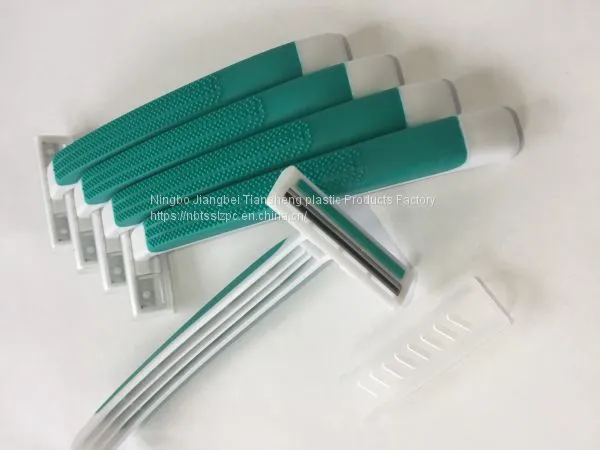
Grip treatment follows material capability. Polypropylene accepts fine mold texture well, so a ribbed or stippled pattern can be cut directly into the tool with no added part.
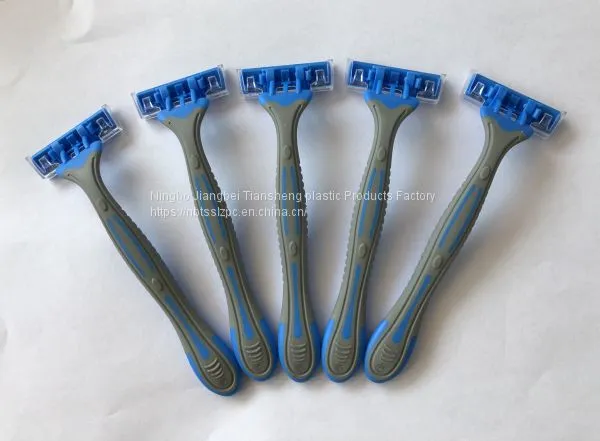
ABS supports a rubber overmold because the two materials bond during molding, giving a soft-touch grip without a separate assembly step. Polystyrene bonds poorly to most overmold materials, which is one reason soft-grip retail razors rarely use it.
A third route is a mechanical insert, where a rubber sleeve slides over the handle. It works with any polymer but adds a part, an assembly step and a failure mode if the sleeve shifts.
For hotel programmes, molded texture is almost always sufficient. For retail programmes where grip is a marketed feature, the overmold route is worth the tooling because the difference is visible on the shelf.
8. Matching Material to Channel and Use Cycle
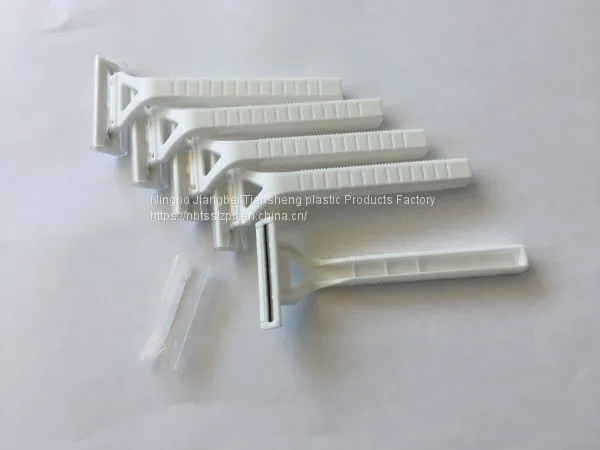
Channel narrows the choice faster than any property table. Hotel and institutional programmes favour polypropylene because the unit is used once or twice, cost matters per unit, and the finish is never compared side by side with a retail product.
Retail programmes favour polystyrene where the razor hangs on a card and the gloss carries shelf appeal, or ABS where the handle is thicker and the product claims durability.
Cold storage is another reason to consider ABS razor handle strength, because impact resistance falls in low temperatures and a brittle polymer fails earlier in an unheated warehouse.
Travel formats lean toward ABS because units are packed loose and handled repeatedly before use, and the thin neck common in compact designs concentrates stress.
A few years ago, a promotional distributor in Africa switched a hotel razor from polystyrene to polypropylene to reduce unit cost and then saw breakage complaints fall rather than rise. The polystyrene handles had been cracking at the neck in unheated storage, and the cheaper polymer was the more durable one in that climate.
A smaller example: a retail brand in Western Europe specified a soft-touch grip on a polystyrene handle and found the overmold lifting after a few weeks on display. Moving the base material to ABS resolved the bond, at a cost increase the brand absorbed by simplifying the packaging.
9. Specification Points That Prevent Disputes
- Name the polymer and the grade, not only the colour
- State target weight in grams with a tolerance band
- State surface finish as molded, textured or polished
- Approve colour on a plaque molded in the specified polymer
- State whether regrind is permitted and at what percentage
- Confirm the shrinkage assumption in writing before tooling
These six points cover the disputes that appear most often after a first shipment. Each is cheap to agree at the quotation stage and expensive to resolve afterwards.
10. Frequently Asked Questions
10.1 Is a PP plastic razor handle good enough for retail
It is good enough for retail where the razor is sold in a sachet or a simple card and the handle is not the main selling point. Polypropylene handles are durable, mold quickly and hold colour well. The limitation is presentation: the surface has a satin sheen rather than a gloss, and a buyer comparing it side by side with a polystyrene unit on a retail card will notice. Many volume retail programmes accept that trade-off because the cost difference funds other parts of the offer.
10.2 When should a buyer choose a PS plastic razor handle
Choose polystyrene when gloss and stiffness are the priority and the unit is unlikely to be dropped onto a hard surface. It suits retail cards, promotional packs and gift sets where the handle is photographed or displayed. Avoid it for travel formats, for thin-neck designs and for cold-climate storage, because the material cracks rather than deforming. It is also the least suitable base for a rubber overmold.
10.3 Does ABS razor handle strength justify the higher cost
It does in three cases: compact travel designs with a thin neck, premium retail handles marketed on durability, and any programme where the unit is packed loose and handled repeatedly before use. Outside those cases the extra cost buys durability the user never tests. A practical test is to drop a sample from about a metre onto tile and inspect the neck, since that is where the difference between polymers shows first.
Recently Posted
-
Men's vs Women's Disposable Razors: Design and Demand Differences
November 26, 2026A buyer opening two cartons side by side often finds that the men's and women's razors inside are closer than the packaging sugges Read More
-
Anatomy of a Disposable Razor: Handle, Head and Blade Explained
November 25, 2026A disposable razor contains between four and nine separate parts, depending on how the blade stack is counted, and each one has a Read More
-
Disposable vs Cartridge Razor: Key Differences for B2B Buyers
November 24, 2026Importers often receive two quotations for what looks like the same product and find a cost gap of 30 percent with no obvious caus Read More
-
Quality Control in Disposable Razor Manufacturing
September 4, 2026A private-label buyer once accepted a large production run based on a favorable sample and a competitive quotation. The first cont Read More

Contact Us
Recommended Products
-
 TS-C229-A Disposable Razor Male FemaleNegotiableMOQ: 10000 Pieces
-
TS-C228 Disposable RazorNegotiableMOQ: 10000 Pieces
-
TS-C239 Disposable RazorNegotiableMOQ: 10000 Pieces
-
TS-C205 Disposable Razor With Two BladeNegotiableMOQ: 10000 Pieces
-
TS-C229A Disposable Razor ShaverNegotiableMOQ: 10000 Pieces
-
Disposable RazorNegotiableMOQ: 100 Pieces
-
TS-C216 Disposable Razor Personal CareNegotiableMOQ: 10000 Pieces
-
TS-C228 Disposable Razor ShaverNegotiableMOQ: 10000 Pieces
-
TS-212 Disposable Razor With Two BladeNegotiableMOQ: 10000 Pieces
-
TS-C229-A Eco-Friendly Disposable Shaving Razor Male FemaleNegotiableMOQ: 10000 Pieces
-
TS-C232 Disposable Hotel Shaving RazorNegotiableMOQ: 10000 Pieces
-
TS-C236 Eco-friendly Straw 2 Blade Shavers Wholesale Hotel Disposable RazorNegotiableMOQ: 10000 Pieces
-
TS-C209A Disposable Razor Shaver Four BladeNegotiableMOQ: 10000 Pieces
-
5-pc Disposable Razor ShaverNegotiableMOQ: 10000 Pieces
-
TS-C219 Eco Friendly Safety Wheat Straw Lady Men Hotel Travel Shaver Disposable RazorNegotiableMOQ: 10000 Pieces